
Buzzlineman is reader supported. If you purchase after clicking the affiliate links, I’ll earn some money- maybe even enough to buy me a new pair of work gloves. You do not pay a higher price.
There’s a good chance that the internet you are using right now to read this article is being supplied by fiber optic cable. Lineman install these fiber cables in the air on utility poles, underground or a combination of both. Fiber lineman need to be able to climb poles and operate bucket trucks.
It’s normal to work outside from the early hours in the A.M. until the sun goes down, which can be both a delight and a drag. In this article we will discuss the job of an aerial lineman.

How Lineman Do Their Job
Fiber lineman use drills and wrenches to attach bolts and clamps directly to the utility pole. Each pole gets a frame which includes a combination nuts, bolts, washers, and other materials. These materials help support the strand and fiber to the pole.
Each pole is unique both in the way the frame is constructed and the actual pole itself- many of these wooden poles are 50+ years old. They can vary in size and it’s not uncommon for a lineman to use bolt sizes 8, 10, 12, and 14 inch bolts in a day.
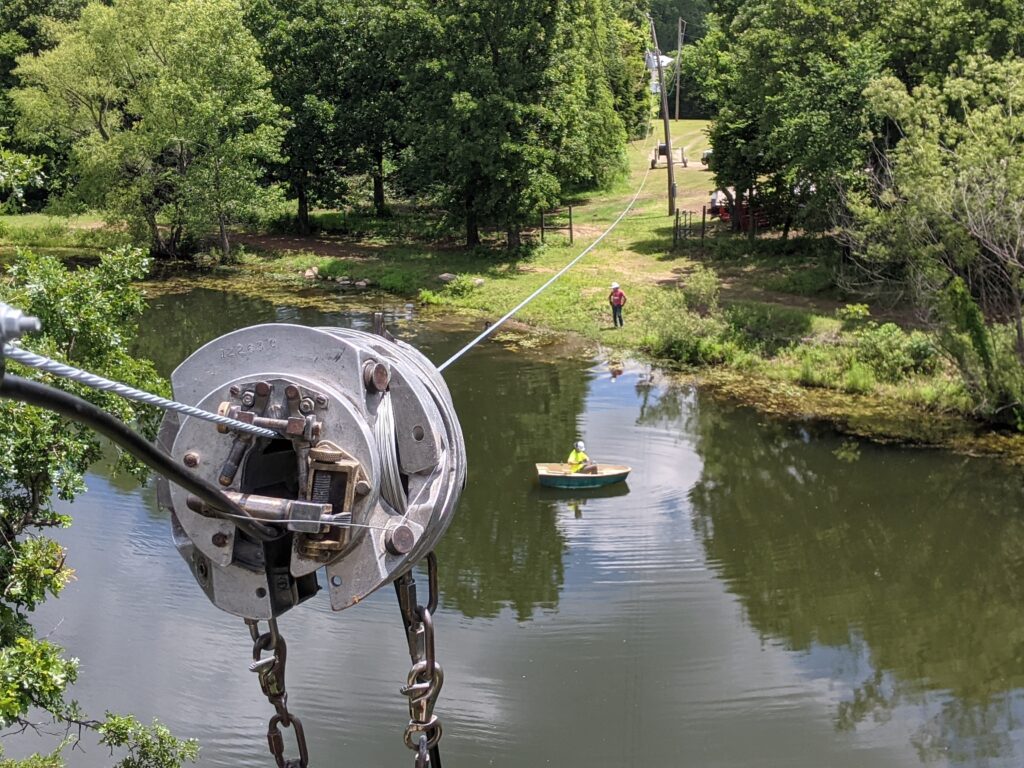
That cable grip helps when we need to do hoist work, pull down guys, or change out frames. It’s a great grip and will last longer than my career 🙂
What are Typical Working Conditions for a Fiber Lineman
The work is year around, but we don’t work in the rain or when it’s cold cold (cold plus the wind is the worst). Most days of the year the weather is tolerable and there are many days throughout the year when the weather is perfect working conditions. Fiber lineman work includes standing on your feet for most hours of the workday. Another aspect is the ability to jump in and out of the bucket.
What is Fiber and how Does it Work?
Originally used to aid doctors with the ability to see inside the human body without major surgery. These long strands of glass or plastic send light signals long distances through the cable and are bundled together to create different sizes of fiber. The most common sizes of fiber count are 12, 24, 48, 96, 144, and 288 with each size getting larger in diameter.
These fibers are protected by thick plastic coating and on the inside a thin jacketing. The fibers are delicate enough that is the cable is twisted or bent at hard angles it can cause the glass fibers to break, not allowing light signals to carry throughout the cable. However, the fiber cable is quite tough and doesn’t break easily, especially the higher counts of fiber- 144 and such.
How Lineman Install Support Strand (Guy Wire)
Most aerial fiber requires lineman to install a galvanized support strand wire prior to fiber installation. To install the strand a lineman will drill a hole in the pole for a frame. Frames vary depending on the situation and angle of each pole. If the pole is straight, it will get a straight 3 bolt clamp with washers and square & lock nuts.
If the pole is curved it will get a curved clamp instead, along with down guy attachment. Another common frame fiber lineman install is a dead end frame. This frame includes a slip eye and a guy hook attachment for a down guy. Both sides of this frame will use preformed guy grips to securely attach to the strand.
Another aspect of installing strand is tightening the wire in the air. In order to do this lineman either uses a hoist which attaches to the pole and then the strand (guy wire). If using the hoist, the lineman will attach a pole strap to the pole and then the hoist to the strap and the other end of the hoist to the strand.
The lineman will then begin tightening the hoist which will raise the line. A quicker method is working in tandem with someone else using a truck, 4 wheeler, or side by side to tighten the strand from the ground. This requires communication and hand signals to correctly place the strand in the air, safely.
Sometimes to get the strand to the pole a rope will be needed. This is the case when crossing wide creeks or when trees are in the pole line. Of course there are many more ins and outs that go along with installing strand. Learning to install strand safely and efficiently takes a lot of experience and learning from others.

How Lineman Install Fiber (Fiber Optics)
After the support strand is finished the fiber is ready to be put up. Fiber is less forgiving, but fairly tough, especially considering fiber is made of thin glass or plastic. However, the fiber is insulated by a jacket and then the black armored protective layer that you see.
Some fiber will also have another black armored layer on the inside. I have broken this fiber many of times before and it’s somewhat tough to do, even when trying. Usually you’ll break the end of the fiber just a couple feet so you can bend it over and tape it. This provides a small loop so a 4 wheeler can pull it out.
The fiber is attached to the support strand by a tool called a lasher. The lasher is able to carry 2 rolls of lashing wire. The lineman will attach the lashing wire to a bug nut and when the lasher is pulled the back half of the lasher spins and with each rotation the wire wraps the strand and fiber together.
A few other parts of the job involve hanging rollers, taps (riser guards), snow-shoes, figure eight piles, and more.
Lineman Tools and Equipment
Strand and fiber require different tools and equipment, but there is some crossover between the two.
Strand involves a drill with an auger bit, bell wrench, channellocks, ratcheting wrench, bolt cutters, tape measure, and lineman pliers. Some important equipment lineman use are hoists, cable grip, and pole strap. Hoists allow lineman to raise and lower the lines and change out bolts/frames.
Some tools involved when installing the fiber include an impact drill, ratcheting wrench, and lineman pliers (nines).
Fiber lineman are essential to providing reliable internet and communication services to the rural areas of the country. The work is physical and a great place to be when the weather is nice. Each day is different and requires a plan based on the obstacles, which keeps it interesting and challenging.
If you are interested in the 10 tools every fiber optic lineman should have check out this article here.