
Buzzlineman is reader supported. If you purchase after clicking the affiliate links, I’ll earn some money- maybe even enough to buy me a new pair of work gloves. You do not pay a higher price.
If you’re a Lineman, then you know that climbing belts are an essential part of your kit. Your belt is the one thing that keeps you from falling to a gruesome death. Climbing belts offer you the ability to properly anchor yourself so you can safely climb the pole and perform whatever task is required such as passing the lasher.
But have you ever wondered if there’s anything else out there? This article will explore different types of climbing belts, how to size them, and some good accessories to add to your belt, plus more.
How to understand a lineman belt size
Getting the correct sized climbing belt is a bit tricky, but not overly complicated. To make it real simple you can take 10 inches off your waist size and that’s typically your D size. But it’s recommended you use a seamstress tape and get a more accurate measurement.
- To measure for your lineman belt, you need to measure from one hip to the other.
- You will start by measuring 4″ below the top of your hip bone and then bring the tape around your butt.
- The number on the other side of the tape should be between 18″ and 32″.
Here’s a good video explanation:
The most comfortable lineman belt
Lineman spend most of their days working on poles, which means a comfortable climbing belt is of high importance. Comfort hasn’t always been an option for lineman, but thankfully we have plenty of options today.
The nylon and polyester climbing belts offer a good balance between flexibility, support and most belts these days come with padding. New leather belts can be a bit more stiff initially, however I started with a broke in leather belt and have used it for years without a single discomfort issue (but I do dislike the gut strap for mobility purposes). If you are looking for a belt that doesn’t sacrifice comfort you will definitely want to consider the 2019 Buckingham Short Back Belt.
This thing is like the Cadillac of lineman belts. The large padded back gives you the support you need for all day climbing. It is Buckingham black in color with their green stitching, looks really nice and is made of leather. Weighing less than 8 pounds and made to fit most body types comfortably. Most climbers love the fact that the 2019 Buckingham Short Back belt takes all the discomfort out of climbing, has the stacked D-rings for secondary lanyard hookup, and let’s you focus on your job. This belt has so much support that you’ll have a hard time even knowing it’s on.
The best lineman climbing belt
The Buckingham Heritage Mobility belt is a climbing belt that, as soon as you look at it, screams quality. The leather is distressed to give the appearance of ruggedness but has already been broken in for a lighter feel. We believe that everyone can find wearing this belt time and again extremely comfortable thanks to the layer of padding for back support so no one will come away from its use with lower back issues, rubbing or chaffing.
Fully functioning stacked D rings are an added bonus as they mean mobility and quick-access when using the secondary lanyard. The lowered placement of D rings has gotten rid of pinch point issues on the hips, which was a problem with the older configurations.
The Buckingham Mobility belt is a climbing belt made for every lineman who needs to climb poles. It will stand up to the toughest conditions and keep on performing thanks to its lightweight design, which is not only strong but durable. This belt is not going to wear out fast and does so many things right. Climbing fast and safely is reality every time you put that climbing gear on.
The most helpful climbing belt accessories
Lineman always need a climbing belt, but it’s not complete without the right accessories.
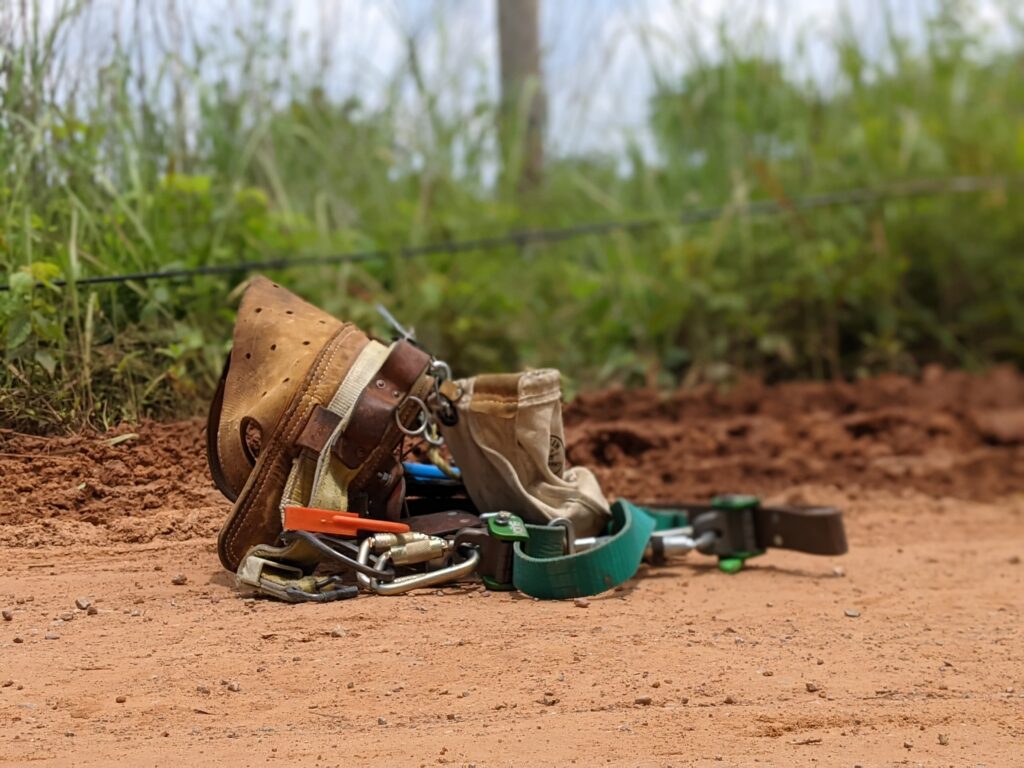
Lineman climbing belt accessories consist of the following: bell wrench, bell wrench holder, tool pouch, ditty bag, handline rope, handline hook for your rope, tape tong, and a 12 inch rope with snap hook (optional, but I love mine). These are the basics.
Lineman Wrench (bell wrench)– technically a tool, but it is on your belt so often I thought it was worth mentioning here. 2 different types of wrenches are available and they both do the job. This will probably be the most important thing on your belt when installing strand. All those nuts need to be tightened down, so a wrench is essential. It doesn’t hurt that it can act as a makeshift hammer 🙂
Bell Wrench Holder– the partner to the previous product. Gotta have somewhere to store your bellwrench on your climbing belt when not in use and this is the accessory you need.
Tool pouch– ideally sized for lineman’s tools, has a spot for everything you need during climbing. Most often the tool pouch consist of channellocks, 9’s (lineman pliers), and a wrench or nut driver. The tool pouch is just what you need to keep your climbing tools in one place.
The Ditty Bag– is a lineman climbing belt accessory that we think is under appreciated. Having a spot to store nuts and other small items while climbing is critical. We love the Klein Ditty Bag because it’s so versatile as well as durable. It can be placed around the climbing belt on either side depending on preference, and often has other tools stored in it that a lineman will need to use quickly. Most ditty bags have a smaller compartment inside the bag to help you stay organized and a hole in the bottom to allow water to drain.
Handline Rope– there just simply isn’t enough space to always have all tools and materials on your climbing belt. So having a climbing rope when installing strand and fiber is a must. A lineman can clip one side of the rope to the strand and pull it up to him. For fiber a rope is used to install riser guards and such. As mentioned above the important aspects of the rope include:
*lightweight
*strong
*bright color (makes it easy to see)
*includes swivel hooks (preference) on both sides
Handline Hook– having a hook or 2 on your belt makes it easily accessible to get to your rope. Technically you could clip your rope to your belt, but you risk it popping off and fall to the ground while climbing. Which always sucks, because you have to climb down the pole and start the process over. Having a hook on your climbing belt is ideal because you can attach your climbing rope and never worry about losing it again. Get yourself a couple handline hooks, they’re cheap.
Tape Tong– usually tape tongs come with the belt, but not always. This accessory is a nice to have so you never forget your tape again.
12 inch rope– This is one of my favorite accessories for the climbing belt. One end is attached directly to your belt and the other has a swivel hook. It allows you to carry more things without help. Some lineman will use their handline rope bring up their drill. This waste time and requires a groundhand nearby to swap out your drill later. With this smaller sized rope connected to the belt it allows the lineman to hook the drill on his belt and then hook the handline rope to the strand. Doing this allows him to have both items hooked up and ready when he gets to the spot he needs to be at towards the top of the pole. When the drill is attached to the handline it needs to be lowered, after drilling the hole. The groundhand then needs to be nearby to take the drill off and then attach the strand to the same handline. This 12 inch rope eliminates the need for the groundhand to do anything because the handline is already hooked up to the strand and the drill is connected to the belt.
Having the right climbing belt accessories can make climbing and installing strand and fiber much easier. It will also save you time which often equals more money for you!
Why a lineman handline rope is important

A lineman’s climbing rope is a very important part of a lineman belt. A lineman’s rope is important for work because it allows you to work safely and reduces the amount of help from the groundhand. It also helps the lineman bring materials, tools, equipment and strand&fiber up and down the pole as needed. Sometimes, items like riser guards, saws, drills and many more have to be used on just one pole. When choosing a rope there are a few things to consider:
1.) Rope length and strength– How long do you need it? A good length for a fiber lineman rope is 20-30 ft. long.
2.) Hook Carabiner/Swivel- Its helpful to attach 2 hook carabiners or swivels (preference) to your rope, one at each end. Adding these will allow you to easily attach tools, fiber, strand, and other materials so you can bring them up to you.
3.) High visibility– It is helpful to choose a color that sticks out or catches your attention. You will be using your rope quite often when climbing, which means it could easily get lost. Sometimes you have to make multiple trips to get all your gear to and from the pole. Things get forgotten, left in fields, and left on the side of the gravel road. Choosing a high visibility color gives you a better chance of seeing your rope so it doesn’t get lost and left behind.
Your rope is important in many different ways. Choosing the best lineman’s rope will help you be more efficient on the pole and make your job much easier. Once you get used to using a lineman’s rope, its really hard to work without one.
What is a lineman belt
Linemen belts are gear used by workers who climb utility poles. Linemen belts are normally made out of leather, nylon or polyester. They wrap around the waist and have a series of rings, called D rings. They’re heavy duty and are designed to hold you securely (even in strong winds). Lineman belts support the lower back while attaching to poles and structures, allowing linemen to work with both hands. Lineman belts allow linemen to carry their tools with them while working on the pole so they can use both hands and access their tools quickly and easily.
Belts started off being made of leather, and although they are still made from leather, there are other materials that are used. Most of the different kinds of belts have a similar shape to them with some small differences in terms of design. The lineman belt consists of 3 main parts:
- A waist strap
- A buckle
- D rings
These three items can be combined into many different designs depending on the manufacturer.
Final Words
We’ve talked about the most comfortable lineman belt, how to size a climbing belt, and a few of its accessories that can make your job easier. If you want to find out more, below you will find the tools and accessories that we recommend and talked about above. I hope this helps!
If you’re interested in the best boots for lineman check out this article that goes into detail discussing some of the best boots available on the market today- The Lineman’s Best Friend: Lineman Boots.