
Buzzlineman is reader supported. If you purchase after clicking the affiliate links, I’ll earn some money- maybe even enough to buy me a new pair of work gloves. You do not pay a higher price.
Cable rollers are one of those often forgot about necessities when it comes to building fiber optic lines. Any pole line that crosses a road, driveway, or obstacle… most likely requires a cable roller. Also worth mentioning is the fact that the majority of the rollers attach to our support strand we install prior to installing the fiber. Here are 4 cable rollers fiber optic lineman rely on to get the job done.
The 4 Cable Roller Types
Let’s start off by mentioning that this job can be completed multiple ways and how I use these cable rollers is what works for me and my crew. Each roller has it’s own unique situation when it can/should be used. The 4 different types of cable rollers include:
- 750
- A Frame/Slap On
- Power Roller
- 90 Block


What is a Cable Roller
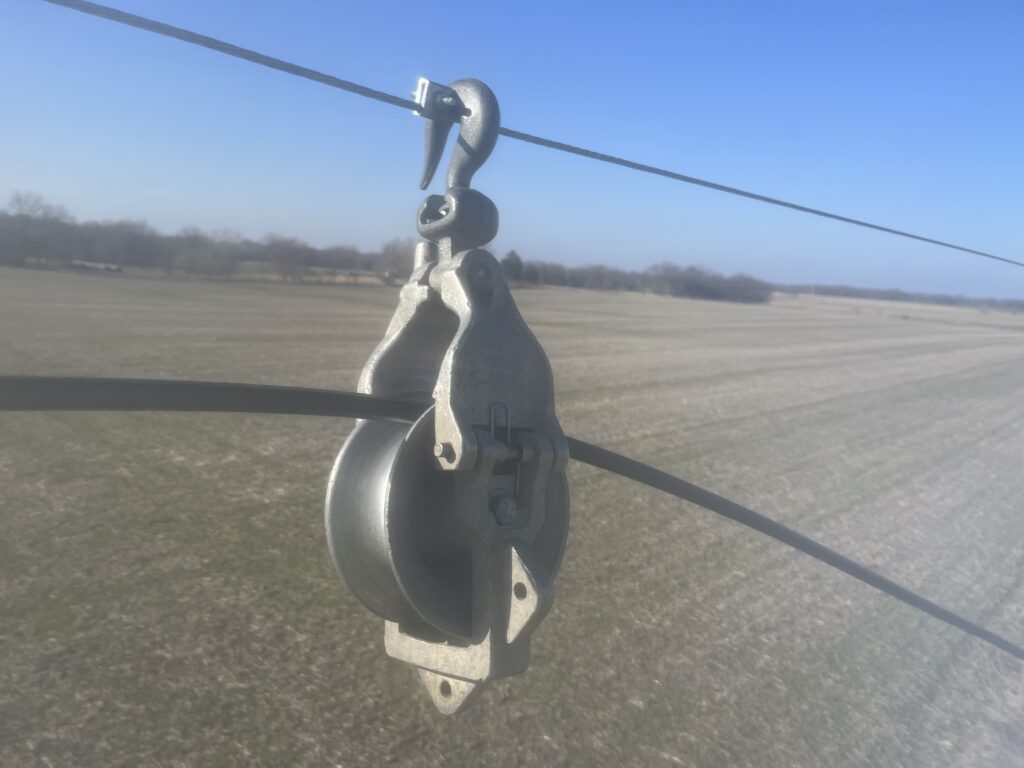
The 4 cable rollers I’m discussing all look different, but consist of the same idea- solid structure with a wheel that spins freely (multiple wheels for the 90 block). Cable rollers spin in the same direction as the cable passing through it. It’s crazy how much of a beating these things take and they keep working well. They are made of aluminum, steel, and/or rubber and secure to existing support lines or pole straps.
What are Cable Rollers used for
Cable rollers are used to keep cable off the ground, away from damage, initial setup, and to make turns when the pole line isn’t straight. The most common reason we use rollers is to allow people to drive under the fiber/cable without damaging it. There are rare times when we will only use a safety cone, such as- when there is a low probability of damage. An old field entrance that hasn’t been used in years is low probability of damage.
If we have to jig out our fiber we will use a power roller initially and sometimes we will use a power roller near the ground with a pole strap to make turns. If there is a 90 degree turn in the pole line we use a 90 block mount.
Why Small Cable Rollers are Important
The small cable rollers are the 750 and the A frame/Slap on rollers. These are going to be the bulk of your cable roller stock pile, because they get used the most. We use slap on rollers when crossing roads. However, I often use 750s when crossing roads- 1 before the slap ons, 1 after.
The 750s are quick and easy, because they don’t require tape like the slap ons do. If you don’t tape the slap ons to the strand they can slide down the pole line, defeating the purpose of placing the roller initially.
I will mention a warning about the 750s- they tend to wear down eventually. The handle at the top of the 750 swings left or right, lock in whichever direction you place it. They have a small wheel that raises when locked and it secures itself to the strand. What fails is that locking mechanism will fail to secure the wheel tight to the strand. When this happens the cable will move much like the A frame without tape. As a reference we have about 40 750s and I would guess 10 of them have this problem.
I also place 750s prior to the fiber entering a 90 block and also when it leaves the 90 block. It is also common to use 750s on 45 degree poles. Place a 750 on each side of the pole, slightly spaced out. You can use those junk 750s that don’t lock on these poles by securing the 750 in place with a bug nut. This works well in these particular situations because the lasher is close to the pole so it doesn’t add much time or effort to remove the bug nut. It’s great to use when you’re on a tough jig and your pile of 750s is almost depleted.

750s get used in many ways, one more includes the 750 in front of the lasher. We do this when lashing 144 count fiber or putting up a snow shoe. 144 count fiber is heavy- placing the 750 in front of the lasher takes a lot of the downward pressure off the lasher. This seems to help the lasher move down the strand line more smoothly AND keeps the wire tight.

How Heavy Duty Rollers Work Hard for you
The heavy duty rollers are the power rollers and 90 block. We use the power rollers almost every time we have to jig out the fiber. We will place it close to the reel so the fiber has a direct uninterrupted path to the air and pole line. During this situation I will also use the bug nut trick, however it is less convenient since the bug nuts will need to be removed prior to lashing that span. While it is ideal to place the power roller near the pole during this time, it is not always possible because of various obstacles.

As mentioned earlier a power roller is often used on curve poles that aren’t 90 degree angles. If it’s a curve in the easement- wooded area with 0 traffic, we will use a power roller with a pole strap low on the pole. This works well because a bucket truck nor climbing gear is needed.
Final Words on Cable Rollers for Fiber Optic Lineman
Cable rollers take a beating and work for you day after day. From the A frame to the 90 block, all 4 of the cable rollers serve a unique purpose in the installation of aerial fiber optic cable. This job can’t reliably be completed without the cable roller, especially 750s and power rollers. We use those 2 rollers nearly every time we put up fiber. Becoming familiar with both small and heavy duty cable rollers is vital to fiber optic linework.
Looking for a new drill? Check out this article we did on the 5 Best Impact Drills for Fiber Optic Lineman.