
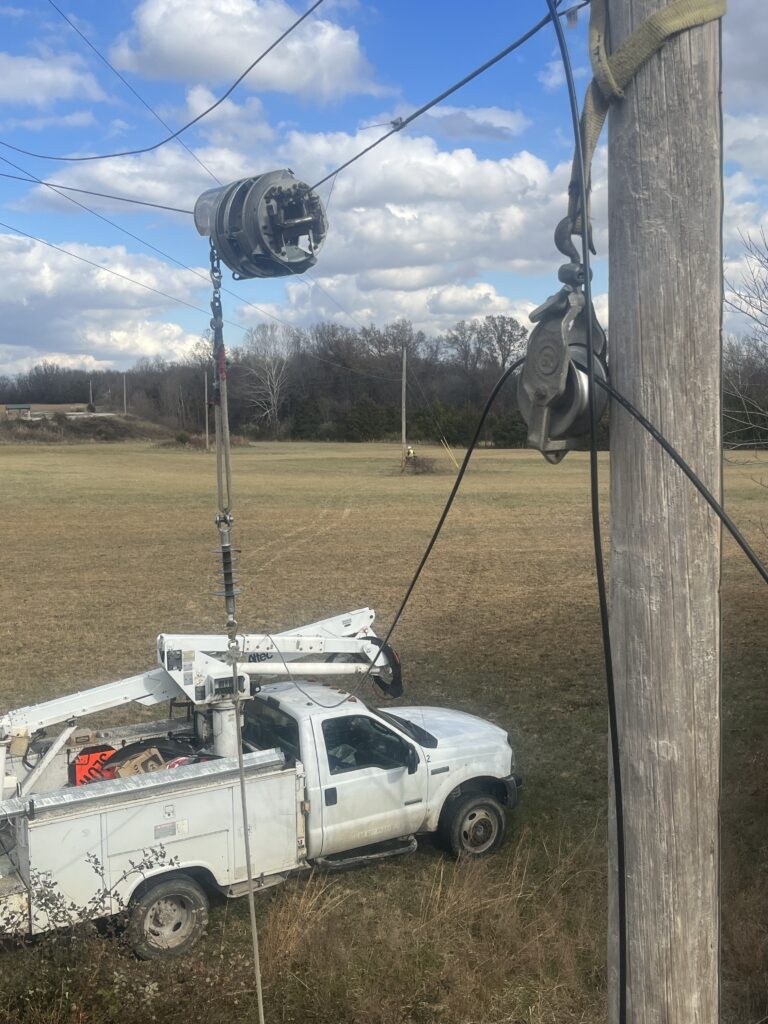
There’s always more to learn when it comes to your craft, job, profession; but here’s what I’ve experienced as life as a fiber optic lineman. This is 7 years, working under a general contractor. I’ve worked for him and his sons during the entirety. I started with 0 knowledge, experience, but more importantly, 0 expectations. Read on to learn more about how fiber and power lineman are different, the money $ you can make, the equipment used and some good insight on life as a fiber optic lineman.
Is Fiber Lineman Hard Work..Yes
Hell ya it’s hard. But not always. Honestly, 60% of the poles I work consists of drilling a hole, inserting 1 bolt, 2 washers, a couple square nuts, make sure it’s all tight, and I’m almost done with that pole. Aerial fiber work really is simple…most of the time.
However, that’s only a little bit of it. And you can’t just know a little bit and thrive as a fiber lineman, you gotta know all of it and there is quite a bit to learn. But like every job, you’ll learn as you go, learn from your mistakes, and figure out how to be more efficient & make more money.
What about the family? I’ve been working away from home this entire time. The closest I’ve ever been to working from home is 2.5 hours. Most have been considerably further away. I’ve always worked 4 days a week, just a few 5 day weeks in my fiber career. I work under a cool contractor that is more friend than boss. But those 3 nights a week you’re away from you’re family, if they don’t travel with you.
Today it lightly rained from 10 a.m. until the end of the work day- we had enough of it around 4. The work was easy, so the annoying weather was tolerable. Lots of crews don’t work in the rain, and that’s how it can be. You have the choice on this job, if you are running the show. Fiber lineman work in the rain, snow, heat, and all the other awesome weather conditions.
The time away from family is rough, the weather can be annoying, and the living conditions are limited also. Most of my fiber lineman career has been spent in small, rural, farm towns, population under 300. Housing options are limited so most fiber lineman travel to the nearest town that has a hotel or 2.
Another option is housing in travel campers. I’ve spent a few years doing the camper with a couple co workers. I spend more time with the people at work than I do my family at home.
How Telecommunications & Fiber Lineman Differ from Power Lineman
Power lines are charged with electricity. I don’t know much about electricity. Honestly, most fiber lineman don’t know much about power lines, which is sad because it’s only a few feet from our head and hands all day.

Power lineman know how to work and maintain the lines that carry electricity from one town to the next. Fiber lineman don’t know how to do that. Fiber lineman work on those same poles, but fiber does not carry electricity. Fiber carries light and is made from glass protected by a hard plastic shell. Some fiber cables have a corrugated armor that adds additional protection to those fragile glass fiber optic lines. Power lines are made of wire, steel, or aluminum.
Power lineman will utilize important gear and equipment to safely protect themselves from electricity, whereas fiber lineman work doesn’t require special safety gear other than hardhats, gloves, and similar simple equipment. In summary a fiber lineman installs wire that carries internet, tv, and phone from pole to pole. In contrast, power lineman install wires that carry electricity from pole to pole.
Why a Fiber Optic Lineman Salary can Vary
I am a fiber optic lineman and I work for a contractor. Some lineman do not work for contractors, they work directly for the contracted company of the project. All the projects I have worked on have been Ervin Cable Construction.
Ervin hires their own lineman, groundhands and other employees. However, they also hire many contractors. Many lineman that work for Ervin get paid an hourly wage, some get paid an hourly rate plus production bonus. Production meaning how many feet of strand and/or fiber you build that week.
Then comes the pay scale of lineman that work for contractors. Some get paid an hourly rate, some a weekly/daily rate, or a percentage. I have been getting paid a percentage for most of my career as a lineman. That works similar to the production bonus. Take the footage total, plus any extras you bill for, and I make 20% of that total top line revenue.
A typical 4 day work week for me usually ends up in the 25,000-35,000 feet. If I get paid 20% of the total revenue off a week like that I bring home about $2,200, per week. This is a typical week, but I have had plenty of weeks where it was lower, and plenty of weeks where it was higher. This past week I had a check of $3,753. There’s definitely money to be made if you want to work hard.
Last year I could have easily made more than the $72,000 I brought home, but I enjoyed 5 weeks off and worked VERY few Fridays and 0 Saturday and Sunday.
Why the Fiber Lasher is the Backbone of Fiber Lineman Work
Fiber and strand installation requires a fiber lasher. There’s no way around it. First you install the strand and then you join the fiber to the strand with wire that dispenses from the lasher. Lashers aren’t cheap, check out this $7,000+ beauty, GMP C Lasher. They are rarely in stock, and not many know how to work on them.

There are a few different types of lashers. The main difference in the lashers is the amount of cables or size of cable that each lasher can hold. For example, the J lasher is able to lash cable up to 3 inches in diameter. In comparison to a C lasher that can only lash cable up to 1 7/8 inches. For me personally, the C lasher works just fine, because we rarely do any overlashing (multiple fibers in the lasher).
Interested in how to operate a cable lasher, read this article, How Fiber Lineman Use a Cable Lasher in 10 Steps.
The Fiber Trailer is Simple, But Crucial
The trailer gets used every single day. It doesn’t get much love, but it’s one of the most important aspects to the job. Not only does the trailer hold the fiber, but it also holds the strand. Most fiber reels are able to fit on the same trailers as the strand. The exception is big fiber reels such as 144 count or 288 count. Those big reels require big trailers that aren’t necessary for hauling strand.


One more crucial note about the trailers we use- they can be dangerous. The shorter, smaller tongue trailers with 2 full reels of strand can be hard to handle and very dangerous.
I have been smacked in the face by the tongue of the trailer after a co worker took it off the hitch. As soon as he took it off the hitch the tongue went straight into the air and then proceeded to flip over. I was unaware he was taking the trailer off the truck hitch and I was standing in the path of the trailer tongue and it immediately swelled my eye shut.
Keep this in mind when deciding which one to purchase, where to drop the trailer while at work, and the best practices for staying safe.

How Dangerous is Fiber Lineman Work
Spending your day close to deadly power lines is absolutely dangerous. It seems like most safety meetings I hear about a fiber lineman getting seriously injured because he got into the powerlines. A few regretful ways fiber lineman get into power include:
- Tightening strand with a truck,4 wheeler, gator, etc. and the strand makes contact with power
- The lashing wire makes contact with power.
- Lineman don’t pay attention where they are drilling and they drill into a power line on the backside of the pole.
- Power insulators break while fiber lineman climb poles or tighten the strand.

Power lines are only 1 of the many ways that make this job dangerous.
Another aspect of doing this job is controlling a 16,000 pound truck with a huge extension arm called the bucket truck. The bucket truck is great, without it lineman would need to climb every pole. However, the extension arm, outriggers, truck itself, and even getting around in the back of truck are all things to look out for. That arm takes on massive workloads daily, eventually things wear, break down and such. To prevent things failing on you 35 feet in the air, maintenance is recommended.
Bucket trucks can flip over if not on level ground (see picture below). Taking a ride in a bucket all the way to the ground is not how you want to spend your Monday morning. Make sure you use your outriggers, pads, and everything else.


Let’s talk about climbing poles. It’s part of the job. I climbed about 8 poles today. Special gear such as gaffs and climbing belts are needed to climb poles. Pay attention to the bucksqueeze components along with the gaffs and climbers. Look over the screws on the spikes, screws at the top of the climbers.
I haven’t had to replace much of my gear except my web strapping of the bucksqueeze.
There is a lot to pay attention to as a fiber lineman. Understanding that and taking precaution from pole to pole is what will keep you safe and with your hands and feet still at the end of the day.
Final Words on Life as a Fiber Optic Lineman
Life as an aerial fiber optic lineman can be financially beneficial, challenging, and good exercise, but it can also be lonely, long hours, and dangerous. There’s a lot to learn on this job, but 80% of it is the same ol’ same ol’. It is a job you feel good about when you look back at the end of the day and see how much you got accomplished.
Fiber crews are usually made up of just a few people and you don’t see many people, keep that in mind if you aren’t a people person. It’s tough to find a crew that work well together, are good at the job, and great pay (if you want to work hard). Give the fiber lineman profession a try if you’re even a little bit interested, it really is a great job.
Need a new drill?- Check out this article about the 5 Best Impact Drills for Fiber Optic Lineman.